Sunday, May 12, 2013

Best Beaches In Tahoe - Sand Harbor


Sand Harbor – (Northeast corner of Tahoe)
Parking – Plenty, but always a good idea to get there early!
Fee - $12 per vehicle
Dogs – Sorry, not allowed, not even in vehicles!
Boat Launch – Yes


Tahoe has many classic, all-natural beaches with tons of sand and crystal-clear water, which, in August, can warm up to an almost tolerable temperature in the 60s.
Some of the classiest beaches of all are at Sand Harbor State Park off Highway 28 on the Nevada side of the lake about 3 miles south of Incline Village.

Sand Harbor is made up of a point of rocks and trees and sand that poke out into Lake Tahoe in a more prominent way than any other place on the shoreline. There is one very long beach facing south, a small and a medium beach facing north, and many little cozy areas tucked into hundreds of giant boulders that look like they were sprinkled onto the area by the Boulder gods.

Talk about clear water


Because of the way the the south-facing beach is protected, the water is often warmer, and you will likely see more people swimming at Sand Harbor than at any other beach on Tahoe.


The park has multiple restroom facilities, a store, and meeting areas that large groups can  rent, making it very comfortable.

Perhaps the most famous aspect of the park is its outdoor stage and natural amphitheater where the Lake Tahoe Shakespeare Festival is held everysummer. This year it is A Midsummer Night's Dream. Click here to get your tickets now.
 There is no other theatrical experience like it in the world. You sit under the stars watching your favorite of the Bard's delights.
Shakespeare on the beach is a great experience.

Behind the stage is the lake. Visible 20 miles away are the snow-capped mountains of the Desolation Wilderness looming over the West Shore.


Look closely down by the waterline, just right of center, and you
will see the rock slide at Emerald Bay (the gray triangle).
This is where the mountain slid away in 1955. 


There's a reason why Mt. Tallac is one of the most photographed mountains on the planet...

If you turn and look northwest, you can see the mountains of Alpine Meadows and Squaw Valley.
In the distance to the northwest are Alpine Meadows and Squaw Valley.


The boat-watching is great. Motor boats with skiers, sailboats and kayaks.


Kayaking Crystal Bay is like magic.


Sand Harbor is a unique and gorgeous spot that - sappy cliche here, but it's true - will give you a spiritual renewal. Highly recommended.

Sunday, May 5, 2013

Best Hikes In Tahoe - Cascade Falls


Cascade Falls (Southwest corner of Lake Tahoe)
Category – Easy, but for sure-footed, experienced hikers only. There are many tall steps and smooth rocks coated with slippery sand designed to make you slip and fall. I strongly recommend hiking boots with real tread. This is not a hike for casual shoes.
View Rating: 9 out of 10
1.5 miles round trip, little overall elevation gain, but sections of up and down.

Snow on the cirque between Mt. Tallac out of sight on the left and
Dicks Peak just behind the 9500-foot ridge in the center. Cascade Falls
is the white mark lower, center right

Everybody loves to go to Emerald Bay, see the Vikingsholm Castle, and hike to Eagle Falls. With its unique and spectacular beauty, Tahoe's only bay is deserving of its countless admirers.
But locals heading toward Emerald Bay often follow Frost's dictum and take the less traveled path out to Cascade Falls. You'll find fewer crowds, views nearly as grand as those at Emerald Bay, and literary antecedents that helped propel a writer toward an eventual Nobel Prize.
Emerald Bay and Cascade lake were formed by two parallel glaciers during the last Ice Age. The Emerald Bay glacier pushed all the way to Tahoe, forming a bay when it melted. The Cascade glacier pulled up short of the main lake, forming Cascade Lake.
Were Cascade Lake and the falls that tumble toward it in nearly any other state, it would be a state park, and freeway mileage signs would count down the distance as you drove the SUV packed with kids and hiking gear. Cascade Falls State Park 98 miles. Cascade Falls State Park 47 miles.
You get the idea. But because Cascade Falls is in Tahoe, it's just another amazing place with no highway signs announcing its presence.

The trail starts off as a pleasant stroll through the forest
Cascade Falls seen from the trail

We had lunch there May 1st. Because of the low snow year, the trail was free of white stuff a month early. Because it was a Wednesday in May, the trail was also free of people. Because the temps were in the 60s, the river and falls were gushing.
To get to the Cascade Falls trailhead, drive to Emerald Bay, but don't go to the popular parking lots for the Vikingsholm Castle or the lower one at the very head of the bay.
Instead, drive to the higher part of the highway south of the bay's head. The Bay View Campground – closed this early in the season – is on the mountain side of the highway, across from the Inspiration Point vista overlook. When the campground gate is closed, you can usually find a place to park near the highway. When the campground gate is open, drive through it to the end where there are several parking places and a trailhead sign just beyond.
Please note that, as with most hikes in Tahoe, it is best to go on weekdays, and parking is best found early in the day. Always resist the bright idea to go hiking late in the morning on Saturday!
There are two trails that depart from the trailhead sign area. The sign explains that you need to fill out a permit for a day hike in Desolation Wilderness, but that only applies to the right trail, which leads up to Maggie's Peaks and Desolation beyond.
Our trail to Cascade Falls is the left one, and you do not need a permit.

The trail has many large steps - not good if you have knee problems.

The trail winds through the woods heading south (where the sun is at 1 p.m. during Daylight Saving Time).
After a hundred yards or so, you come to the edge of the glacial moraine that forms the northwest side of Cascade Lake. The view over Cascade Lake is immediately spectacular.

Cascade Lake with Tahoe in the far distance

The trail goes along the side of the steep moraine slope. Cascade Falls will appear in the distance to the south. Lake Tahoe dominates in the distance to the northeast. Heavenly and the 10,900-foot Freel Peak massif spread out to the southeast.
As you approach the falls, you will be tempted by many beautiful places to sit on the rocks by the rushing water as you eat your lunch and maybe even dangle your feet in the ice water that only melted minutes before.
This is a fine idea but requires a word of warning. If you slip and fall in the water, you could be sent off the cliff. This especially applies to children and dogs etc. Enjoy your visit and all its beauty. But please don't become a statistic!
Looking down from the upper part of the falls

The rushing river above the falls
Lunch above Cascade Lake with Tahoe in the background

Stellar's Jays are beautiful but noisy birds. This one was looking for a handout that didn't come.
While you munch your lunch, ponder what it was like in 1926 when the 23-year-old John Steinbeck left Stanford and got a job working as a caretaker for the Brigham family estate on Cascade Lake. (The lake is still largely private, so we are very lucky to have a public trail to Cascade Falls.)
Steinbeck was a caretaker on Cascade Lake 1926-1928

Steinbeck worked on his first novel while snowed in during that first winter in Tahoe. From where you sit near the falls, you can look to the northeast end of Cascade Lake and visualize some of the locations that influenced Steinbeck's perceptions about landscape and loneliness.
Behind you is a large cirque of mountains leading up to the 9974-foot Dicks Peak. 
These are the snow fields that feed Cascade Falls. Look very closely
and you can see three avalanche tracks on the upper snow field.
The one on the upper right looks to be about 1000 feet long.

The cirque contains two good-sized lakes, Snow Lake and Azure Lake. They are scenic, but be aware that the trails to them are over bare rock and are not well marked. It is easy to get lost.
If all you do is have lunch at Cascade Falls, you will be well-rewarded. The round trip is short, but the views and memories will stay with you forever. Okay, not forever, but they'll occupy your neural synapses until you supplant those memories with your next amazing Tahoe experience.
Sunday, April 28, 2013

Best Hikes In Tahoe - Angora Ridge Lookout


Angora Ridge Lookout (South Shore)
Category - Easy
View Rating: 10 out of 10 once you get to the lookout, 5 out of 10 on the way up
3.5 mile round trip to the Fire Lookout, 500 feet elevation gain
5.5 mile round trip to Upper Angora Lake, 800 feet elevation gain


Within the Lake Tahoe Basin are hundreds of fantastic hikes. Many are well-documented classics, like those around Emerald Bay or up on the Tahoe Rim Trail.
On this blog, I will periodically mention some hikes, but I'll often focus on those that are less well-known and not in all the guide books. These hikes will still have something substantial to recommend them, whether views or solitude or bird-watching or beach-picnicking.
With recent temperatures in the 60s combined with a low snow year, many great trails have already opened a month earlier than normal. One is Angora Ridge Road. Hiking up Angora Ridge is not like a charming, single-track, wilderness trek, but most of those are still buried in snow for another month or two.
Plug “Angora Ridge Road, South Lake Tahoe” into Google Maps, and you'll find your access between Fallen Leaf Road and Tahoe Mountain Road.
The beginning of this road is at a Forest Service Gate. Yes, when the gate is open, you can drive the one-lane, mostly-paved route, but why? Walking is the key to smelling the piney forest, hearing the birds, getting blood to your brain and heart.
What recommends this hike is that it is an easy access to a fantastic lunch spot at the old Angora Fire Lookout, and the views are spectacular. It is also a great hike for groups who would like to do a “Walk-and-Talk,” because it is a relatively wide thoroughfare compared to most single-track hikes. Instead of being spread out single file, only able to talk easily at a lunch spot, Angora Ridge Road is the perfect venue for a group of four or more who want to get some exercise instead of just sitting on someone's deck.
Mountain Biker going through one of the last snow patches on Angora Ridge Road


Yes, you will have to move aside for the occasional vehicle crawling up to Angora Lakes Resort, but if you avoid going on the weekends, the vehicle count is minor inconvenience.
The road climbs at a gentle-enough angle that even people who avoid hiking because they feel it is too much work may find it agreeable.

At first, the road sits in a cleft on Angora Ridge. After a mile, it begins to rise up enough that Mt. Tallac pokes up above the ridge on your right. 

Mt. Tallac appearing on your right as you walk up Angora Ridge


Then the road pops out on the top of the ridge at 7200 feet and all of Tahoe Valley appears below you on your left (including the 2007 Angora Fire burn area which came up to the top of the ridge you are walking on but did not cross over and go down the other side).

Steven's Peak at the end of Christmas Valley with the Angora Fire burn in the foreground:


To the east is the Country Club Golf Course on Highway 50:


The old fire lookout buildings will be on your right. Just a few feet from the fire lookout is a bench and an information plaque. From the bench area you will have jaw-dropping views of Fallen Leaf Lake 800 feet below you with Lake Tahoe in the distance:

Fallen Leaf on lower left, Tahoe in the background, snow on Mt Rose 30 miles to the north


 I know... a writer should know better than to use cliches like jaw-dropping, but my jaw drops every time I visit, so there you go.


 Mt. Tallac looming 2500 feet above you:


The 10,000-foot Crystal Range up Glen Alpine Valley:


Here's a close-up of Pyramid Peak:
Lots of spring corn snow for back-country skiers and boarders


Fallen Leaf Lake 800 feet below with Stanford Camp on the distant shore:


If you like, you can hike another mile to the family-run Angora LakesResort

Upper Angora Lakes/ Angora Lakes Resort

They have 9 cute little cabins on Upper Angora Lake (there are two lakes – hike on past the lower one) that are all booked months and even years in advance. Rumor has it that they are already booked solid for this coming season. They serve lunch sandwiches and lemonade starting in June, and you can sit at the upper lake and watch the kids jumping off the cliffs into the water at the far side of the lake.

Whether you go all the way up to Upper Angora Lake or stop at the Fire Lookout, Angora Ridge is one of the easiest hikes close to South Lake Tahoe, and it has great views.

UPDATE: 10-4-14

Signs that say "No Parking Any Time" have just appeared near the entrance to Angora Ridge Road. I have no idea why other than to suppose that the hike has gotten too popular and many cars are now parking at the side of the narrow road (could this blog be that influential?). Perhaps someone didn't get their vehicle far enough off the road and the authorities decided it was a public safety hazard if there wasn't enough clearance for fire trucks and such. Of course, I am disappointed. However, parking on public roads is legal where not marked as prohibited, so I recommend arriving a bit earlier and parking above the signs in the Angora Highlands neighborhood. From the Angora Ridge Road gate, go up toward the Angora Highlands houses on the narrow road (which is still called Tahoe Mountain Road). You will come to an area where the asphalt widens. This area is before the first houses and above the highest No Parking sign. You can park off to the side and not obstruck traffic or bother any of the homeowners. 

You could also park down by Fallen Leaf Lake Road if you like, although that would be farther from the gate. Consider the extra minute of walking as bonus exercise! When you get to the view up at the old fire lookout, you will think it was worth it.

Sunday, April 21, 2013

Pull Up A Chair To Owen McKenna's Kitchen Table...


The single best thing about being an author is getting up in the morning and reading fan mail. People write to say what they liked about my books. And occasionally they point out glitches and mistakes and other things I've overlooked!
A couple of days ago, I got a really fun email from a reader named Debbie. In addition to complementing my books, she pointed out some discrepancies about Owen McKenna's kitchen table in my various books. This was interesting because I haven't thought much about Owen's culinary environment. I guess I should pay better attention!
I've put Debbie's letter below, followed by her notations of my table descriptions.
My return note to Debbie is below that.

Here is Debbie's letter:

Firstly---let me say I LOVE your 10 books!  I just finished #9, since I started w/#10....then went in chronological order---I now have my sweetie reading them.  Your Owen McKenna series is as exciting as the Lee Child's Jack Reacher series.
Anyway...
I am an avid reader, and noticed spelling mistakes...but, the mistake that bothered me the most---was---does Owen have a kitchen table or not?  I didn't cut & paste all the references---but, I do want to know!
Thank you!
Debbie

Another reference to "Owen"  having a kitchen table:
as I carried it to my little kitchen table
Borg, Todd (2011-07-15). Tahoe Hijack (An Owen McKenna Mystery Thriller) (Kindle Location 1780). Thriller Press. Kindle Edition.

and again!
Diamond sat with me at my little kitchen table.
Borg, Todd (2008-08-01). Tahoe Avalanche (An Owen McKenna Mystery Thriller) (Kindle Location 1268). Thriller Press. Kindle Edition.
add this:   entrance to my kitchen nook. Her eyes were wild, ransacking my homemade butcher block table and Shaker chairs,
Borg, Todd (2007-08-01). Tahoe Silence (An Owen McKenna Mystery Thriller) (Kindle Locations 111-112). Thriller Press. Kindle Edition.


Dear Debbie,

Thanks so much for writing. I'm glad you are enjoying the adventures of Owen and Spot!
I believe you've set a new bar for astute kitchen-table observation! I'm impressed! Of all the letters I get about writing details, you are the first to notice my discrepancies regarding McKenna's kitchen table.
To bring you up to date:  
McKenna used to have a crude, home-made butcher block table.

But one day, Spot, in his excitement about going for a walk, spun around, hit the table, and broke off one of the table legs. The table top fell to the floor and cracked in half. McKenna used his splitting maul to turn the butcher block table into firewood for his wood stove, and the heavy pieces heated his cabin for two weeks.
McKenna ate standing at the kitchen sink for a few days and then found a cracked vinyl table top for free at a garage sale (no one was willing to pay the $4 price), and with some hinges from Scotty's Hardware in South Lake Tahoe, he attached it to the wall of his kitchen nook.


The laminated table is homely, but the hinges work great. When it's folded out of the way, Spot can now push his food bowl around the area without bumping so many obstructions.
As for the spelling mistakes you've noticed, I claim no excuse. Were I to attempt an explanation, I'd venture to say that most are of the homophone kind: altar/alter, rein/reign, peek/peak etc. I clearly have a neural dysfunction that permits me few graces in the spelling department.
Fortunately, many readers point out the spelling errors to me, and they gradually get corrected in reprints. 
Thanks again for your thoughtful culinary comments, although I must now confess to a bit of trepidation about my new book, which is due out in August. Does Owen eat at the counter? The table? Is it still made of vinyl? We'll know in a few months!
Sincerely and earnestly (Really!),

Todd


Sunday, April 14, 2013

Do Dogs Grieve?


Years ago, when our first Great Dane was two years old, we learned of a Great Dane pup that needed rescuing. We never knew what the puppy's owners were struggling with, but we saw the need for a new home for the puppy when we went to their apartment and found the puppy chained to the handle of a kitchen cupboard, barely able reach its food and water.
The people were relieved to have us take that dog off their hands. We named her Scarlet.

That little puppy grew up to be the happiest, sweetest dog you could ever know. She clearly was connected to us in every great doggie way. But Scarlet had an even greater devotion to our other dog. Watching those two dogs play together was a great joy. Their emotional connection was deep and obvious.
Eventually, the inevitable happened, and our first Dane died at the age of 10. Scarlet, now 8, was so profoundly depressed that she couldn't function in any way. She stopped eating, drinking, sleeping, playing. The dog who lived to run wouldn't even walk. Desperate, we took her to the vet.

My wife's sketch of Scarlet with her nose tucked under her paw

After examining her for a few minutes, the vet said, “I hate to tell you this, but it appears that your dog is dying of grief.”
We asked, “Is there anything we can do?”
He said, “I can't promise it will save her, but I think your best hope is to get another dog as soon as possible.”
We immediately went dog shopping and brought home another puppy.
The effect on our depressed dog was slow, but she began to get better. She began drinking and eating. Eventually, she rediscovered play. She went on to live until the age of 13, the oldest Great Dane our vet had ever seen.

As all pet owners know, the emotional lives of animals are as real as the emotional lives of people. Yes, people might be more complicated, but our emotions are no more profound. When you watch dogs play, it is obvious that their joy is just as joyful as that of any human. And when you watch a dog dying of grief, you can't deny that it is their depression that's killing them. Animals under severe stress sometimes give up and die just like humans do.
Scientists studying animals – and the general media that reports on them – made another small step forward into the obvious this week as Time Magazine did a story on Animal Grief. (Note that you have to be a subscriber to read the entire article.)  The article reports on scientists who've studied how various species deal with the death of their own. They looked at elephants and apes and dolphins and crows and horses and, of course, dogs and cats, and they found significant and unmistakable signs of serious grief in the animal world. Many species even have complex rituals they enact when one of their own dies.

I've written about animal intelligence and emotion before: 

This new article in Time Magazine prompts me to visit the subject again. Scientists are coming around. They've slowed down their knee-jerk impulse to label our observations of animal emotion and animal intelligence as anthropomorphizing, the unfounded attachment of human qualities to animals.
Some day, the experts will finally recognize what the rest of us have always known. Animals have lives that are nearly as rich and full of complex behaviors and social structures as the lives of people. (It seems that some of the time, some animals have richer and fuller lives than some people!)


When a Dolphin baby dies, the mother shows profound and complex grief. She keeps lifting the dead baby to the surface for days, and other Dolphins join in a long-term mourning ritual, refusing to leave the dead baby.

People are clever, and we are lucky enough to have opposable thumbs, which led to specialized brain development (imagine what dolphins might do with opposable thumbs!), but it's arrogant to think that our suffering when one of us dies is greater than the suffering animals endure when their loved ones die. If your grief is powerful enough to kill you, it's all powerful, regardless of what species you belong to.


Sunday, April 7, 2013

Beauty Follows Science, or Sailing On Lake Tahoe is Another Kind Of Wind Power


I often watch the sailing regattas on Lake Tahoe and admire the beauty of airfoils designed to extract power from the wind.


A few weeks ago, I saw a second cousin to those gorgeous sailboats.
I was driving through the Mojave Desert when I overtook a slow-moving truck with a flashing sign that said “Oversized load.”
Wow, talk about understatement. You know those logging trucks where the cab is connected to the rear wheels not by a truck structure but by the logs themselves? This truck was like that, except it seemed like it was maybe 200 feet long.
I slowed as I moved into the left lane to go past.
What I saw was a fantastic, beautiful, monstrous curve of white. It may have been made of fiberglass or titanium or some other techy material. I couldn't tell. It curved in all three dimensions and brought back hazy memories of reading about hyperbolic paraboloids from science texts back in college.
I thought it was the largest – and one of the most beautiful – abstract sculptures I'd ever seen. Then I realized what I was looking at.
It was a single blade for a monster wind turbine.

I slowed my car, matched speeds with the truck, and stared at this wing that was much longer than those on a 747 jet and, with its complicated multiple curves, probably more complicated in design. It was like an America's Cup sailboat-meets-Mars-mission technology.
Up close, it was one of the coolest things I'd ever seen, a beautiful shape that was designed to extract power from the wind. It was beautiful because the the science behind its design made it that way.

It is humbling to realize that the science of function is integral to many things of beauty. When I look at the spectacular sails of the boats out on Lake Tahoe, I realize that their beauty comes from a design that is all about function. 
WoodWind II Sailing Cruises on Tahoe

After seeing that huge turbine blade, I can never again look at the spinning blades of wind turbines without seeing them like sailboats. These are sails that turn. They take the invisible wind and turn it into electricity. A wind farm with many turbines is like a regatta with many racing boats. Instead of producing an afternoon thrill ride on the water, the turbines power our lights and appliances.
Beauty follows science.


Sunday, March 31, 2013

Tucson Festival Of Books

I was one of the authors exhibiting at The Tucson Festival of Books, held on the University of Arizona campus. 


It was a great time, and I met a lot of mystery readers. And who wouldn't want to visit warm, sunny Tucson in March? Saturday was cloudy and rainy and windy, but hey, the temperature got all the way up to 47 degrees. Locals called it "a severe weather event." But the sun came out on Sunday, and the thermometer practically broke as it punched through to 56.

At night in the hotel, I was able to get some writing time in on my laptop.

My artist wife got some drawing in as well. Here is her sketch of me working on my laptop as I ruminate on the next adventures of Owen and Spot.

Sunday, March 24, 2013

Wait, How Big Is Tahoe? 29 Years!


You've all heard the statistics about Lake Tahoe. They're on the back of restaurant menus, on calendars, in the wikipedia articles, on the travel websites. Length (22 miles), width (12 miles), depth (1635 feet), total water volume (150 cubic kilometers).
Tahoe From Space

Okay, it's a big lake. But how big is it in terms that we can understand?
Here's a statistic you've never heard.
I decided to run a few numbers. I wanted to know this: If every person on earth drank eight glasses of water a day and they dipped it out of Lake Tahoe, how long would the lake provide everyone on the planet with drinking water? A day? Several days? A few weeks?
We've got a bit over 7 billion people on this planet. That's a number too big to really grasp. Line up 7 billion 5-foot, 6-inch people and they'd stretch around the earth 291 times. Put all of us head to toe and we'd go to the moon 30 times. That's a lot of people. So if we're all drinking our recommended intake from the lake, how long would it last us?
Over 29 years.*
That's a lot of water from one mountain lake.
So the next time you drink a glass of water, invite everyone else on the planet to join you. Let's everybody do it eight times a day for 29 years.
Live large. It's Lake Tahoe.


*For those of you who want to do the math, there are a bit more than 4 eight-ounce glasses in a liter, a thousand liters in a cubic meter, a billion cubic meters in a cubic kilometer, and 150 cubic kilometers in Lake Tahoe. Divide by 7 billion people, then divide by 8 glasses a day, then divide by 365 days in a year, and you get 29 years. That's a lot of water.

Sunday, March 17, 2013

The Joys Of A Fictional Dog


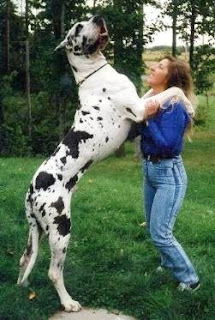
Spot, as many of you readers know, is a 170-pound Harlequin Great Dane. He's also fictional.
Dog Breed Info

He seems real, as I've learned from the number of emails I get telling me to say hi to Spot and give him a pet.
I based his personality on a combination of the three Great Danes we've owned. Same enthusiasm, same goofiness, same levity – life's a game!
Of course, real Danes have some pretty amazing traits that Spot can only do in our imaginations. What's my favorite? Well, it's hard to beat the way a real Great Dane, when you're sitting in a chair or on the couch, will walk around behind you and drape his giant head down over your shoulder and lay it on your chest, his ear right next to your mouth. When you whisper into the ear of a Dane who's doing this, you can sense the slightest movement in his head as he wags his tail. He won't lift his head up off your chest unless you push him away. He just wants to be as close to you as possible.
Of course, there are some advantages to fictional Danes. They're a bit easier to train. It's less work to pick up after them. And if you have to suddenly leave town, there's no scramble lining up a dog-sitter.
But there's no substitute for the real, living, breathing, wagging thing.

Sunday, March 10, 2013

The Most Important Thing About Research


At nearly every talk I give, I get a question about how I do my research. I always explain that I usually spend some time Googling my questions about a topic. (Sometimes I just type in a few disjointed words. Sometimes I type in an actual question.) The results that pop up range from fascinating to dead ends. At each step, I think of other questions. I end up clicking through a wide range of links, and usually I get so interested in the topic or related topics that I learn much more than I need for a particular part in a book.

Sometimes, after I've learned the basics, I'll call an expert. The reason is that while you can read enough about some subjects to become quite knowledgeable, you may find that your writing about it, while technically correct, doesn't have the right flavor. Talking to an actual person can make a huge difference.
This is one of the most fun things about writing. I track down an expert, call them up, tell them I'm working on a new book that has a story thread about (insert subject here: forest fires, avalanche control, autism, long-lost Mark Twain manuscripts, weapons, art forgery, gold mining, search and rescue, genetic engineering). You get the idea.
I've never been turned down. I assume that's because people like to be helpful, and they probably also welcome a break from their routine. Going out to have coffee with a writer who wants to pick their brain is more fun than a typical meeting at the office.
Another kind of research is exploring the arena in which you are writing. For me, this can range from hiking and skiing and biking and sailing around Tahoe to traveling to other cities and visiting places that might turn up in my books. I may even explore museums that house the kind of stuff I'm writing about. Sometimes, I poke around libraries or businesses that intersect with my subject matter.
In sum, research is fun and enormously interesting.
Which brings me to the most important part of research.
You have to know when to quit.
When you've learned enough for your purposes, it's time to stop researching and write your book.
Thorough research is critical to getting most stories to work well. But research has caused more writers more procrastination than anything other than email and other internet distractions.
Learn what you need, then turn it off. It's time to write.
The Thinking Center

Sunday, March 3, 2013

Tahoe's Clarity Is Improving!


 The UC Davis scientists who study this stuff dangle the Secchi disk (basically a white dinner plate or a black-and-white plate) down off the shady side of a boat at mid-day. They lower it until they can no longer see it, at which point they note the depth. After they start pulling it back up, they again note the depth when the plate reappears. Often the two figures vary a bit, so they average them. And just to make sure that they are getting reliable data, they do this measurement many times during the course of a year.
The average for 2012 was 75 feet. The lake hasn't been that clear since 2002.
UC Davis's John Le Conte research vessel
Before we get too excited and smug, it is good to remember that when they started taking these measurements in 1968, that little Secchi disk could be seen 102 feet down!
While this improving trend is great, the reasons why it is happening are less clear. At this point, the best guess is that the main mitigation has come from all of the infiltration ponds that have been built to catch and filter runoff water from streets as well as rebuilding creeks that once had meandering paths and flood zones but were dredged and straightened by developers in years past.
There is lots more to do. There is still a scary number of drainage pipes that dump dirty storm runoff water directly into the lake. These have been documented by the Tahoe Pipe Club.

There are infestations of non-native mussels and fish that lead to algae blooms. There are massive ongoing erosion areas from old road cuts such as Meyer's Grade.
And there are other problems that might be even harder to tackle, such as the nutrient load from dust and dirt that blows in from the Central Valley, especially when the farmers are plowing or burning slash. Scientists have even identified silt that has blown into the lake from China's and Mongolia's Gobi Desert after a dust storm half a world away.
But for now, we are glad that the lake is improving, and we salute those individuals and groups that made it possible!