Sunday, November 24, 2013

Notes For Writers - What, At Its Core, Is A Story?

Last week I taught another 3-day workshop at the Sacramento Fine Arts Center called:

The Hook, The Twist, and The Cliffhanger
What Works, and What Doesn't, in Entertainment Fiction

It was a great group - a dozen writers from as far away as Minnesota, all focused on the most effective ways to write fiction and find an audience for it. As always, the camaraderie, comments, and critique were insightful and fun. The repartee was continuous and funny (writers are very intelligent and quick with the clever, wry observation), and our discussions were interrupted with frequent laughter.
We all - myself included - learned a lot. We went away with new motivation and new friends.
As I've taught more workshops over the last several years, I've realized that there is a strong desire in the writing world for more information about a wide range of subjects connected to writing.
I've decided to periodically do blog posts to add my small contribution to the corner of cyberspace that is devoted to writing.


Here is one called Tell Me A Story. What follows is a short description of those components that make up most popular stories. Farther down is an expanded version.

Tell Me A Story
We are hard-wired to respond to stories that contain certain elements. Tell a story with these elements to the youngest children, and they will identify with the protagonist and demand to know what happens. Children don't need to be taught this response. It is innate.
Look at bestselling novels. Look also at popular movies, which, compared to novels, are simply stories that are somewhat abridged. Movies are great to study because they distill stories down to the most compelling story elements. (A movie usually operates off a screenplay with 90 - 120 pages. The average novel ranges from about 280 pages to 450 pages.)
In all popular stories, the same components appear again and again.

Here Are The Basic Elements Of Popular Entertainment Stories

TROUBLE
The story opens with a sympathetic character, the Protagonist/Good Guy, in serious trouble with the Antagonist, which is usually a Bad Guy.
As the character tries to deal with the trouble/Bad Guy, things gets worse.
When the character takes a new approach, the trouble gets even worse.
THE TROUBLE GETS MUCH WORSE
Just when we think that things couldn't possibly get worse, it gets much worse.
THE TROUBLE BUILDS TO A CLIMACTIC BATTLE
In a final effort to cope with the trouble, the protagonist goes to battle with the Bad Guy/trouble, usually on the Bad Guy/trouble's turf.
Although the protagonist appears to be seriously out-gunned, he wins the battle with persistence, resourcefulness, and ingenuity.
A SHORT RESOLUTION
Once the climax is over, the story is wrapped up as fast as possible.

Here is a deeper explanation of the story components:

Tell Me A Story - Expanded

(Joseph Campbell first brought the broad understanding of story to the general public in his book The Hero With A Thousand Faces and also, with Bill Moyers, in the PBS series The Power Of Myth. Campbell explained that all of the great mythic stories along with nearly all popular stories, contain the same elements. Throughout history, disparate cultures independently created stories that all follow this pattern.)

How and why is the protagonist a sympathetic character?

The sympathetic character is our protagonist (the Hero). At the most basic level, she has some goodness. Because she is sympathetic, we identify with her. Why? Because we clearly understand her hopes and dreams, her worries and fears, her yearnings, desires, wants. She has emotions and we understand those emotions. Without emotions, she would be a cardboard character, going through the motions of the story, but we wouldn't care. The hero's emotions are critical. The hero also has flaws, which make her more believable and more sympathetic. The hero's flaws are critical.

What is the trouble?

Trouble is the antagonist or the agent of the antagonist (the Bad Guy). The trouble can also be a non-human bad guy, for example, alcoholism. But almost always the trouble is a very nasty person.

How bad should the trouble be?

The trouble should be as bad as possible. The trouble should be life or death. (Think Shakespeare's tragedies.) If the trouble is the likelihood of actual death, great. If not, the trouble should be the likelihood of the death of all that the character cares about.

What does it mean for the climax to be on the bad guy's turf?

When the protagonist goes into the climactic battle, she steps over the threshold into the “mysterium” (mysterium tremendum is Latin for overwhelming mystery), the antagonist's turf, where previous rules don't apply, where all bets are off, where the unknown appears to be in charge. Even more important, once on the antagonist's turf, the protagonist is hopelessly out-gunned. The antagonist has the advantage of greater power, greater skills, and greater knowledge.

Why does the protagonist's ingenuity matter?

When the protagonist confronts a superior antagonist/bad guy, the only advantage the protagonist has is her persistence and ingenuity. Just when we believe that she is going to succumb to the Bad Guy's superior strength/smarts/preparation, she reveals surprising ingenuity and resourcefulness, and that makes the final difference, allowing her to triumph in spite of overwhelming odds against her.

Why should the resolution be short?

After the climactic battle, the tension is gone. The resolution (the denouement) should wrap up a few loose ends (not necessarily all loose ends) and then be done, always leaving the reader wanting more.


If your fiction follows this pattern, you are well on your way to a story that large numbers of readers will want to read.


Keep on writing!


Sunday, November 17, 2013

The Problem With Great Danes At Talks

When I do events, people always ask me if I have a “real” Spot and if so, why don't I bring him to my talks?
I tell them that we've had three Great Danes, but we're currently dogless. My schedule would make life unfair for a Dane. I couldn't bring the dog along, either. One could put a tiny dog into a “Spot Rocks” bag and carry it into the hotel. But not a Great Dane!
Well, I think you should have 'a Spot' and bring him to your talks,” people say.
It's a fun idea, but the truth is that if I brought a Great Dane to any event I did, no one would pay any attention to me! Everyone would be gaga over the dog, petting and hugging him.
Would my readers prefer to spend time with Spot rather than listen to what I have to say?
Of course!
Which means that any future Spot will stay home for the foreseeable future.


"Was that the microwave beeping? I like my Danishes nice and warm."

Sunday, November 10, 2013

Notes For Writers - Three Simple Ways To Stay Disciplined

People often think that it must be hard to actually sit down and force yourself to write. The truth is the opposite. All you need to know are three simple things that make it all easy.
1) Write something fun.
If you are slaving away trying to create an artistic masterpiece, you are doomed to writer's block. Pretentious aspirations will crush any work ethic. If instead, you are writing the kind of novel you love to read, the writing is fun. At the worst, if you get stuck on a given scene, put it aside until you get a new idea of how to deal with it and start another scene.
2) Consider the alternative.
When you compare writing to any onerous task - doing household chores, standing in line at the DMV, coping with rush hour traffic on the way to your day job, shoveling snow when it is very cold - it is easy. Think about it. You sit down with a cup of coffee and make up a story. How hard is that?
3) Spend a day writing in a new, great place.
Writers have it over those with any other occupation in that you can do it anywhere. So why not do it anywhere? Grab your pad of paper or your laptop and head to the beach, or the lake, or the coffee shop on the corner. Want to expand the concept? November is the shoulder season everywhere. All across the country, tourists have left resort areas. It is the perfect time to take long walks, undisturbed, and talk out your novel to yourself. Use some vacation days and rent a cabin in the woods to channel your inner Thoreau. If you are in an urban area, the city parks are mostly empty, especially on weekdays. From Central Park to Golden Gate Park, a writer can find solitude and beauty.

Bring a chair, bag lunch, and your laptop, and you're set for a peaceful day of writing.


Yesterday, I took a bag lunch and went out to Hope Valley, which is where the Mormon Emigrant Trail came over the Sierra, 15 miles south of Tahoe. While Hope Valley sits at 7000 feet, the fall sun was warm. It was the perfect place to sit on the West Fork of the Carson River and do some writing. The only interruptions were a few trout jumping. It was a perfect location to write some intrigue. I highly recommend such a break!

If you get stuck, a walk to take in the views will give you a recharge.

Sunday, November 3, 2013

How To Change Your Weather

For those of us who live in the mountains, there's a variation on the weather jokes. Don't like your weather? Go up or down a thousand feet.
On a quick road trip up I-5 to Seattle last week, I noticed that the snow on Mt. Shasta came down to approximately 7000 feet of elevation.
Mt. Shasta in Northern California

 Farther north, I noticed that the snow on Mt. Hood came down to approximately 6000 feet.
Mt. Hood in Northern Oregon
We expect this, of course, because it gets colder as you go north.
If instead of going north, we'd gone south the same distance from Shasta we could have been to Mt. Whitney. There, the lowest snow level would have probably been around 8000 feet.
So I wondered if there is a regular relationship between where you are on a north/south basis and where you are on an elevation basis. After a little research, I found out that there is, and it matches what I noticed on the way to Seattle.
All other things being equal, going 300 miles north changes your climate approximately the same as going up 1000 feet in elevation.
Of course, in most scenarios, all other things are not equal. If you go farther from or closer to the Pacific Ocean, which is a huge modifier of climate, that will change things as much or more than anything else.
But it is still an interesting comparison. Going 3000 miles north is like going up 10,000 feet. So if I were to start in Sacramento, which is near sea level, and go to the northernmost reaches of the Canadian arctic (3000 miles), my temperature change in any given season would be similar to going from Sacramento to the top of Heavenly ski resort at 10,000 feet.
Useful information?
Maybe not. But fun!


Sunday, October 27, 2013

Animals That Understand Pointing

When our first Great Dane was young, she loved to chase squirrels up trees. She never caught a squirrel - Great Danes aren't that quick. But she loved the chase.
One day when we were walking in the woods, we saw a squirrel in the distance, a squirrel our dog hadn't noticed. One of us put our hands on either side of our dog's head and pointed her head in the direction of the squirrel. She immediately saw it, ran after it and sent yet another furry creature into the high branches.
From that moment on, we could turn her head toward anything and she understood that there was something interesting to see. Beyond simply holding her head, we could bend down so that our arm was next to her head and point. She understood that looking down our arm was the same as when we physically turned her head.
She would hold still, looking with great focus, until she figured out whatever it was we wanted to show her. Birds and airplanes became as interesting as squirrels, all because she understood that we wanted her to notice them.
It turns out that this is a big deal in the world of people who study animal cognition. The reason is that a simple pointing gesture, understood by people from the time they are babies, and understood by dogs who've been trained to understand pointing, is not understood by most animals. Even Chimpanzees don't get pointing. It seems so basic, yet our closest relatives in the animal kingdom are oblivious to pointing.
Enter the elephants!

We've known for a long time that elephants are really smart, surpassing dogs in self-awareness (they recognize themselves in mirrors, whereas dogs think they are seeing another dog). Now it turns out that elephants understand pointing.
A recent study showed that elephants, even young elephants get pointing.
The study had lots of details, but suffice to say that if you give an elephant a treat, then point at a bucket that contains another treat - a bucket sitting among other empty buckets - the elephant will follow your point and go to the bucket with the treat. No training required. Here's the story from NPR.
The scientists are now wondering if elephants point, using their trunks, perhaps, to point out important things like food or water or a group of lions. Maybe we've simply never noticed.
We train dozens of different kinds of animals to do complicated tasks, from seeing-eye service dogs to dolphins that find underwater mines. Maybe elephants are even smarter.
Those of you who read my books know that Jennifer Salazar, McKenna's wealthy young patron, is studying elephants and looking for ways to help them survive in a world full of poachers. Maybe a future book will have something about elephants and their amazing intelligence!
Hmmm, I wonder how Spot would react to an elephant. Probably, an elephant would be like a giant horse, an intriguing source of new scents, a curiosity, a creature that is non-threatening yet something to be careful around. Could be a fun scene to write...


Sunday, October 20, 2013

When Is The Weather Perfect In Tahoe?

In many places, fall is the best weather of the year. Tahoe is no exception.

The air is cool, the sun is hot, the views are spectacular, and the crowds have vanished, waiting until the ski resorts open before they reappear to dance on the slopes. (It won't be long. Some of the resorts are already making snow, and we've had snow at higher elevations.)
Unlike the mountains of New England, Tahoe doesn't have many maples and other deciduous trees that put on a spectacular color display. Why? Because Tahoe gets too much snow, which breaks the limbs of most such trees. Our pines and firs are designed to handle crushing snow loads.
Some people plant ornamental maples in areas where less snow falls, but they aren't common.
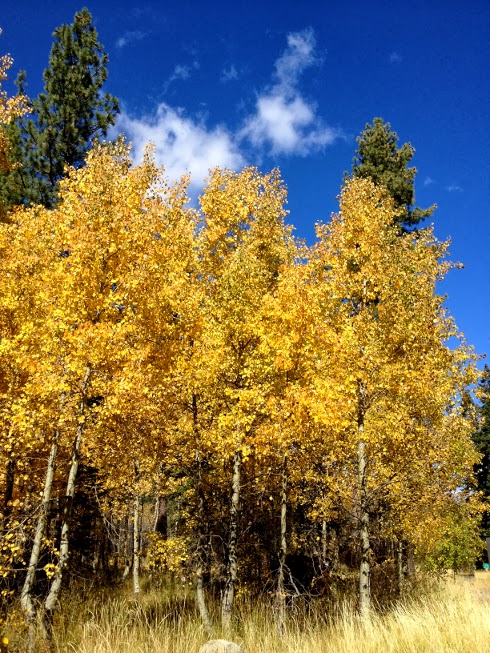
Nevertheless, Tahoe does have fall color in those places that don't get too much snow and also have higher-than-normal ground moisture. Such a combination results in groves of Aspen. Going for a fall walk under the Aspen is like immersing yourself in a golden glow. Here are some pics from a few days ago.

Often, the first sign of fall in Tahoe is when Tahoe's highest mountain,
Freel Peak, gets a dusting of white.

The Aspen groves begin to glow.

Their leaves make a startling contrast to the pine and fir and sky.

Walking underneath is like going into a stage set  with all the amber lights turned on.

The same conditions that support the Aspen (ground moisture)
also support lush meadow grass.

Hot sun streams through. A guy could take a nap in the grass
and dream the dreams of John Muir  150 years ago.

When the weather in the Gulf of Alaska shifts and sends the first major
storm down the coast, this landscape will be buried in several feel of snow.
Sometimes, it doesn't happen until the holidays. But it could happen by the end of October.
Tahoe locals know that we should enjoy the fall whenever we get the chance!

Sunday, October 13, 2013

The Kokanee Are Running!

Back in the 1940s, somebody - eager fishermen, perhaps- decided to take Sockeye Salmon from the Pacific Ocean and introduce them to Lake Tahoe. These days it is generally considered inappropriate to move species to areas where they haven't previously existed. (Remember the agricultural inspection stations - the "bug stations” - at all of the highways coming into California. The reason is that introduced species often wreak havoc in their new territory, displacing native species and eating crops.)
Whether it was a good or bad decision to bring in the Sockeye - there's evidence both ways - these introduced Sockeye Salmon took well to Lake Tahoe. As a saltwater fish that used to return to freshwater streams only to spawn, these Sockeye turned out to be fine living in fresh water all year long. As a now-land-locked freshwater fish, they've been renamed Kokanee, a Native American word for freshwater silver trout.
Like their saltwater forebears, Kokanee spawn by swimming up the creek or river where they were hatched.
Taylor Creek on the South Shore of Lake Tahoe flows from Fallen Leaf Lake to Lake Tahoe. Of all the 60+ streams that flow into Lake Tahoe, Taylor Creek is the main spawning area for Kokanee Salmon.
Each fall, a portion of Tahoe's Kokanee turn from silver blue to brilliant red as spawning approaches. Then they return to their birth site and swim up Taylor Creek to spawn and die, their bodies providing a feast for our bears and Bald Eagles among other carnivores. 
Kokanee live for several years before they spawn, so most of the population don't spawn in any given year. Because they die after their first and only spawn, Kokanee are known as semelparous fish, coined for Latin for "beget just once." The colloquial phrase is "Big Bang reproduction."
How do the fish know where to go for this one-time event? It is a mystery, this combination of chemistry and scent and mapping and navigation hard-wired into their DNA. Is there something else? Is there learning involved? Because Kokanee live for several years, do the younger fish learn by watching the older fish go to their spawning grounds and then die?
It used to be that people thought fish had little if any intelligence. But recently, studies have shown that fish can recognize their friends! We've underestimated the intelligence of nearly all animals. So what about fish? Do they observe their elders and figure out what to do next?
Either way, it is a spectacle to observe. When I checked out Taylor Creek a few days ago, there were thousands of fish.
Most years, the Kokanee run begins in early October.
To get there, drive from South Lake Tahoe north on 89 (Emerald Bay Road) about 3.5 miles. Taylor Creek is easy to spot as it is a good-sized creek, and there is a bike/walking path bridge just to the north of the vehicle bridge. You can't park right near Taylor Creek, but you can park at the side of the highway a bit farther from the creek. During the salmon run, you will see lots of parked vehicles, the occupants of which are all wandering the areas near the creek.

Look at the color of this guy flashing through the fast water just below a cataract.

Looking upstream toward Fallen Leaf Lake. Taylor Creek flows about 2 miles to Lake Tahoe.


People congregate on the bike path bridge to watch the salmon.


Looking down from the bridge, the Kokanee Salmon are coming upstream, toward  us.


Where the water is slow, the fish rest in a group of thousands.


The mountain water from Fallen Leaf Lake is crystal clear.


Sunday, October 6, 2013

Notes For Authors - What's The Best Way To Make An Impression On Readers?

The Best Way To Make An Impression?

It's likely - but not certain - that the answer is to write a really good book. In fact, everything I say after this sentence is predicated on the assumption that you have written a really good book and that your book also has a really good professional cover and really good editing. Further, an additional assumption is that you are going to repeat the process multiple times, because few things make more of an impression on a reader than multiple books, especially those in a series.

But back to the main topic:

It's likely that the second best way to make an impression is to personally meet readers, talk to them about your book, and, if possible, get them to realize that you're a halfway decent and interesting person. You don't even have to be especially charming, although it's great if you are.
Many readers like to try books by authors they've met. They are naturally curious about writers. “She seemed really smart. I wonder what her book is like.”

Meeting Readers In Person

A person who reads a book by someone they've never met may - if they like the book - remember it and the name of the author who wrote it. But after a few months, their memory may falter. “There's this book I read that I liked, and it was by this author whose name escapes me, and I guess I can't really remember the book, either.”
But if the reader meets the author of that really good book, they will probably remember that author and her books for years and maybe even forever. Then, when the reader discovers that the author has come out with a new book, they may buy it. When they're trying to think of books to give for holiday presents, they will remember the author. And they will be pleased to tell the people on their gift list that they met the author.
Speaking for myself, of all the books I've read and liked, I've probably forgotten most of them along with the authors' names. Sorry! But I remember every single one of those books where I've met the author and also liked his or her book.

Be The Author "Entertainment" At An Event

I do lots of events where I can meet readers. I speak at libraries, service clubs, book clubs, schools, and author events. I exhibit books at all of those plus many art & wine festivals, street fairs, and any other events where there will be a lot of people, such as at the state fair. I've spoken to retirees and little kids and every age in between. I've spoken to cops and firemen and professional women's groups and college students and writer's groups. And of course, I do bookstore talks and signings.
A quick count on the “Events” page of my website comes to about 250 events I've done since 2008. (And that doesn't count dozens of non-public events - private gatherings where I've spoken - that aren't on my "Events" page.) Many of the events I do are multiple-day events. Many are events with a thousand people walking by every hour, most of whom probably weren't even interested in books. But for the 5% who were, I ended up making hundreds or even thousands of impressions.
Ever since my books began selling well enough that I could quit my day job, I've been a full-time writer, which gives me advantages of time and flexibility. But like most writers, during the period I wrote my first four books I had to work the day job 6 days most weeks and constrain book events to my limited time off.
That can be hard. But for most people, there are still 52 weekends a year. That's a lot of time for events. And many people with day jobs can get vacation time off. I did, too, and I spent much of those vacations working on my books and book business.

Like most writers, in the beginning, I focused on bookstore signings. I soon learned that while a good bookstore can do wonders for your career, most do not. At many bookstore signings, I struggled to connect to anybody among the very few people that wandered the aisles.
I soon realized that if I gave talks, I would meet many more people. So I polished up three different talks and gave them for free to any group that would have me.
From there I segued into larger events. I spent multiple vacations exhibiting at the L.A. Times Book Festival where over 150,000 book lovers attend. Exhibiting at that festival is great! But the reality is that I shared that very large crowd with 650 other authors. Same for the Tucson Festival of Books as well as all other author events. (I really like the Sonoma County Book Festival in Santa Rosa.)  It's hard to make an impression when you are just one of hundreds of colleagues all selling books.
But those shows are still good to attend, as are any and all events where you personally meet readers.

Festivals Are Where The People Are

Eventually, I discovered that exhibiting at events and festivals where I am the only author, or one of only two or three authors, is hugely more rewarding. As I mentioned earlier, most people attending such festivals could care less about authors. In fact, it could be that many people at such festivals, like much of the general public, rarely read.
But for those people who are addicted readers, I stand out. “Oh, look, there's an author here! Oh, look, he writes mysteries! Oh, look, they're set in Tahoe!”
Next thing I know, I've sold a book or three. And if the person likes my books, they may remember me forever. By the end of the festival I may go home with significant receipts. (Of course, the money is the least valuable part. The biggest reward comes when those buyers read the book that I signed for them and they love it enough to order up all the rest of my books and then tell their friends about it. For a beginning author, making money is the least important. Getting books out there is more important. Finding life-long readers is most important.)

All Authors Need To Learn How To Sell Books

In the beginning of my writing career, I worked very hard to sell a few books. (At one bookstore signing, I sold just a single book. Ouch!)
The first hundred books an author sells are hard-won sales. But you need to buy 100 copies of your book and go out there committed to selling them. That is the only way you will learn the process. Know that it will be very hard. That way you won't be so discouraged.
The second hundred are only marginally easier because, while you have begun to learn what matters to readers, you still won't have built up any readership that one could call a following.
The first thousand books sold are a huge milestone because it proves to yourself that you've learned the basics of how to connect to readers. And it proves that many of those readers liked your book enough to recommend it to their friends. Further, it indicates that when you spend ten times the focus on your newly-refined efforts, you will sell ten times as many books.
Sometimes, an author will seem to be struck by a lightning bolt of success after their first book is published. Their story is splashed across the media. As a percentage of all authors, it's a very rare event.
Most authors build their career bit by bit. Success in most fields only comes after dogged persistence. If you do enough events and do them long enough, and if you write enough good books, you will succeed.

With Time And Effort, You Will Find A Good Audience

I credit much of my career to all those author appearances.
My most recent event was the Candy Dance Festival held in Genoa, Nevada last weekend. The place was a mob scene, and I met a lot of people and sold a lot of books. More importantly, as I've said, I found a lot of new readers.
At the end of the festival, I discovered that one of my author friends, Stan Paher of Reno, was also there exhibiting his books. When I asked how the show went for him, his grin was impressive.
So write some really good books, then get out there and meet people. Keep the faith, and be persistent. You might be surprised at the career you can build.
Gotta go now... I'm exhibiting my books at the Minden Library Author Day in two hours. And then I pack my car full of books to do a Bay Area show in Los Altos this weekend.

The Candy Dance festival in Genoa, Nevada each fall brings a huge crowd.
Having an author tent at this and other festivals is a great way to meet readers.

Sunday, September 29, 2013

Best Hikes In Tahoe - Meyer's Grade

Category - Easy
View Rating - 6 out of 10
Distance - 3 miles round trip
Elevation gain - 700 vertical


Meyer's Grade isn't in the hiking books because it isn't a classic trail through the woods. So why is it one of the most popular hiking/biking spots in all of Tahoe, especially for locals? Because it is easily accessible year 'round, and it is one of the classic walk-and-talks. Unlike the narrow single track trails that fill the hiking books, this is a real road where vehicles aren't allowed, so groups of people can walk side-by-side and visit while they exercise. (For me, as with many people, the single track trails that climb up the mountain are my favorites. But I hike Meyer's Grade more often because of its accessibility.)
Meyer's Grade is the old highway from Echo Summit down to Meyers, the first community that you come to in Tahoe when you arrive on Highway 50.
To get to Meyer's Grade, take Highway 50 to the point where it starts to climb up Echo Summit. Turn off on South Upper Truckee Road. (This is just “up” from the bridge over the Truckee River.) Drive south about 1/10 of a mile, then turn right.
You are now on Meyer's Grade. This is the old highway, narrower and steeper than the current highway. You'll come to a locked gate. Park anywhere on the shoulder below it. Caltrans maintains Meyer's Grade, and even plows it occasionally in the winter because it is the back-up road in case an avalanche or an accident blocks the newer highway.
This means that Meyer's Grade is the ultimate people's highway, free of cars and trucks. It is just for pedestrians and their dogs. (Again, leash laws apply. You will see many people with their dogs running free. But if the Animal Control officer shows up and finds your pooch off-leash, you will face a stiff fine.)
A few hardy bicyclists also use the grade, but most days you won't see them.
(We know a man who takes his unicycle up and down “The Grade.”)
Meyer's Grade makes a gentle, curving climb up 1.5 miles and 700 vertical feet. At the top is another locked gate where it joins the newer highway.
All along the way, you'll get great views of Christmas Valley below, Stevens Peak to the south, and Lake Tahoe in the distance to the north.
Sometimes, you can hike the grade and see very few people. Other times, you will see many, young and old, even moms pushing strollers. (Yes, there are multiple, super-fit young mothers who push their kids up and down 700 vertical feet every day! Imagine what kind of shape they'll be in when they get to 50 or 70.)
Plug “Meyers Grade, South Upper Truckee Road, South Lake Tahoe” into Google Maps, and you'll be able to print out your map.


After you walk past the locked gate at the bottom, the road climbs up at a gentle angle.

As you climb, you begin to get some nice views.
The light areas, below center, are the sides of the road you've just walked up.
In the distance, the gray stripe without trees is the path of the
Angora Fire. Back in 2007, it burned from left to right and took out 254 houses.
Fortunately, no one died.
It was started by an illegal campfire.

On the left side of this dead tree perched a large hawk.

After a rest, it flew away.

In a moment, it found a thermal updraft, and it rose high up into the sky.

When you get to the top of Meyer's Grade, you come to another locked gate.
This view is beyond the gate, looking back down from where we've come.
How wonderful to have a road just for pedestrians!
To the left, you can see a car driving down the current, newer highway.
The cars all drive along unaware that hikers and bikers have
their own highway that descends, at a steeper angle, to the right.

From the top are great views. In the distance on the left is Heavenly.
Come winter, thousands of skiers will have a great time, skiing from California to
Nevada and back. Who knew you could ski from one state to another?
Hiking Meyer's Grade is a great way to get a sense of what Tahoe locals do for everyday exercise. Come join us!

Sunday, September 22, 2013

Best Beaches In Tahoe - Kiva Beach

Kiva Beach - (Southwest corner of Tahoe)
Parking - Not very much, get there early!
Fee - NONE! More reason to get there early.
Dogs - YES! More reason to get there early! Note: Bring a leash! (More below.)
Boat Launch - No, unless your boat is a kayak, paddleboard, or canoe that you can carry to the water.


There are few places where dogs can frolic in Lake Tahoe. When one of them happens to be a spectacular beach, you can bet it is popular. When there is also no parking fee, you know where the crowds are going to be.
Because of these factors, Kiva Beach is one of the most popular beaches on the lake. Located east of Baldwin Beach and west of Camp Richardson and in the Tallac Historic Site, it is close to South Lake Tahoe. Even during slow periods, Kiva often has lots of people when the other beaches are mostly empty.
As always, if you plug, "Kiva Beach, South Lake Tahoe" into Google Maps, you'll get the appropriate picture. However, Google puts the little marker pin on the straight section of narrow beach. The most beautiful portion of the beach is the curved area to the west. Walk around, you'll find it.
So lets go back to Kiva's raison d'être: Dogs.
Dogs are allowed, but there are some rules. They have to be on a leash. Yes, you'll see dogs running free, and you'll be tempted to let yours join them. But be aware that if a ranger shows up, you'll pay a hefty fine, rumored to be in the $200 range. The rules even say you have to have your dog on a leash when it's in the water. You be the judge.
It goes without saying that you must pick up after your dog.
Dogs are also not allowed on the meadow behind the beach. Too ecologically-sensitive. (The meadow, not the dogs.)
As for the beach? It is a beautiful crescent of sand with great swimming and awesome views, very much like its neighbor Baldwin Beach, which doesn't allow dogs, and does charge for parking.

Bottom line: If you want to bring your dog to the beach, and you want it to be beautiful, Kiva rules like no other.

Turn off the highway at this sign. It is about a quarter mile west of the Camp Richardson Hotel.

You will drive in and come to a fork in the road with this sign. Take the left fork.


The left fork road brings you to an oblong oval parking lot. On the west side is a somewhat inconspicuous trail.
That's your path to doggie heaven.

Pay attention to the dog rules.

The trail goes back about 100 yards to the water.
The beach you probably want - the large, crescent-shaped beach - is on your left.
To your right is a much narrower beach that makes for a nice walk down
toward Valhalla and Camp Rich.
The backdrop to Kiva Beach is Mt. Tallac on the left of this photo and Maggies Peaks
to the right. Yes, your thought about the name origin is accurate. Maggie was a shapely maiden.

Kiva Beach rocks for dogs. But of course, there is always a flip side. If you have young kids who are afraid of dogs, drive down to Baldwin Beach and pony up for the parking fee. See my previous post on Baldwin Beach.


Sunday, September 15, 2013

Best Beaches In Tahoe - Baldwin Beach

Baldwin Beach – (Southwest corner of Tahoe)
Parking – Plenty, but always a good idea to get there early!
Fee - $7 per vehicle
Dogs – Sorry, not allowed, not even in vehicles!
Boat Launch – No, unless your boat is a kayak, paddleboard, or canoe that you can carry to the water.


As the bulk of the tourists return home in September, Tahoe's beaches become even more attractive. By several measures, Baldwin Beach may be Tahoe's greatest beach. It is a mile long and quite broad from water to the shore plants, it has great swimming if you're brave when it comes to cold water, and it has great views of the lake as well as of Mt. Tallac and Maggies Peaks. Further, if you're looking for a good place to launch your kayak for a great paddle to Emerald Bay, Baldwin is the closest public beach.

Looking east toward the ski runs of Heavenly
Looking west toward the mountains that border Emerald Bay

Behind the beach is Mt. Tallac, snow-covered in the spring and early summer and beautiful in the fall.


Baldwin Beach has picnic tables and barbecues as well as nice rest rooms (a big benefit at a beach). Bring your sweetheart or your family and friends for one of the great Tahoe beach experiences.
Get there early to claim a picnic table


Waiting for cheeseburgers


The nicest beach restrooms on the lake

Baldwin Beach has parking closer to the beach than most, especially the west lot (turn left at the T).


Baldwin Beach is bordered on the west side by private property and on the east side by Taylor Creek, which drains Fallen Leaf Lake. East of Taylor Creek are Kiva and Pope beaches. More on those in another post.
Please note that the water in Taylor Creek is very cold and swift in the spring and early summer. It is also deeper than it looks! While some people wade through the creek when the water is low in the fall, I do not recommend taking the risk. You could possibly get swept out into the lake in the ice cold current.

How to get there:
Baldwin is a bit over 4 miles northwest of the “Y” intersection in South Lake Tahoe. Head out 89 toward Emerald Bay. When you see the Camp Richardson Hotel, drive another 1.4 miles toward Emerald Bay and look for the Baldwin Beach sign.

If you plug “Baldwin Beach, South Lake Tahoe” into Google Maps, you will get what you need.
While they charge $7 per car to drive in, you can park for free in a lot just before the check-in building. The walk in is a pleasant half-mile or so.
You will come to a T with parking lots to both the right and left. I prefer the left lot, although, if you're walking, it is a greater distance. Also, if you want to rent a kayak, the vendor usually sets up on the beach near the right lot.
The beach closes to vehicles in the middle of October, although you can still walk in after that. In the winter, if it isn't snowing and the roads have been plowed (i.e., making it safe to park without getting towed), you can park on the highway and cross-country ski or snow-shoe in. Baldwin is a fabulous winter picnic location on the lake with few, if any, other people around.


There is a fenced area to protect the endangered Tahoe Yellow Cress, the only place in the world where this little flower grows!

A rainbow of colors to choose from, but note that the kayak vendors only come when there are enough people to justify it. If the beach is mostly empty, there won't be kayaks to rent.

Bring an umbrella, lots of sunscreen, and a mystery novel to read, because Baldwin Beach is a sweet place to spend an entire day!